How to help middle-aged adults suffering from depression, cognitive strain and severe loneliness to restore their mental health?

Midlife was once considered a time to enjoy the fruits of one’s years of work and parenting. However, as numerous studies show, this is no longer the case in the U.S.
Today’s middle-aged adults in the U.S.– ages 40 to 65 – report more daily stress and poorer physical health and psychological well-being, compared to middle-aged adults during the 1990s. Despair, cognitive strain, loneliness and chronic pain among middle-aged adults have been increasing for the past decade. These trends are most pronounced for people who attained fewer years of education.

The very nature and expectations surrounding midlife are shifting. The U.S. middle-aged adults are confronting more parenting pressures than ever before, in the form of engagement in extracurricular activities and pressures for their children to succeed in school. Record numbers of young adults are moving back home with their middle-aged parents due to student loan debt and a historically challenging labor and housing market.

Today’s middle-aged adults need to take on more caregiving-related duties for their aging parents and other relatives, while continuing with full-time work and taking care of school-aged children.

The high level of continuous stress that people experience every day results in a significant increase of mental health disorders. Psychologists and medical professionals offer various psychological practices and medication-based treatments to help people get rid of or alleviate their sufferings and distressing states.
Positive psychotherapy developed by Dr. Nossrat Peseschkian
One of the effective psychotherapeutic practices that helps people in many countries of the world restore their mental health is positive psychotherapy (PPT), developed by Dr. Nossrat Peseschkian in 1977.

As an integrative and transcultural method, positive psychotherapy has been applied for more than 45 years in more than 60 countries and is an active force within a “positive mental health movement.”
Why ‘positive’ psychotherapy?
The term “positive” implies that positive psychotherapy focuses on the patient’s possibilities and capacities. Symptoms and disorders are seen as capacities to react to a conflict. The Latin term “positum” or “positivus” is applied in its original meaning—the factual, the given, the actual. Factual and given are not only the disorder, the symptoms, and the problems but also the capacity to become healthy and/or cope with this situation. This positive meaning confronts the patient (and the therapist) with a lesser-known aspect of the illness, but one that is just as important for the understanding and clinical treatment of the affliction: its function, its meaning, and, consequently, its positive aspects.
Positive psychotherapy integrates approaches of the 4 main modalities of psychotherapy:
- a humanistic view of human beings
- a systemic approach toward culture, work, and environment
- a psychodynamic understanding of disorders
- a practical, goal-oriented approach with some cognitive-behavioral techniques.
The concept of balance
Based on a humanistic view of human beings and the resources every patient possesses, a key concept of positive psychotherapy is the importance of balance in one’s life.
The balance model (Figure) is the core of positive psychotherapy and is applied in clinical and nonclinical settings. This model is based on the concept that there are 4 main areas of life in which a human being lives and functions. These areas influence one’s satisfaction in life, one’s feelings of self-worth, and the way one deals with conflicts and challenges.
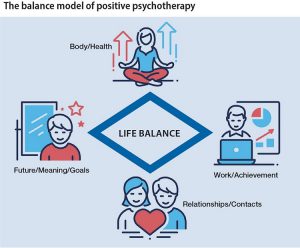
The balance model emphasizes an equal distribution of energy (not time) to each of the 4 main areas of life:
Body/Health
Future/Meaning/Goals
Work/Achievement
Relationships/Contacts
LIFE BALANCE
Although all 4 capacities are latent in every human being, depending on one`s education, environment, and zeitgeist, some will be more developed than others. Our life energies, activities, and reactions belong to these 4 areas of life:
- physical: eating, tenderness, sleep, relaxation, sports, appearance, clothing
- achievement: work, job, career, money
- relationships: family, friends, acquaintances and strangers, community life
- meaning and future: existential questions, spirituality, religious practices, future plans, fantasy.
A goal of treatment is to help the patient recognize their own resources and mobilize them with the goal of bringing them into a dynamic equilibrium. This goal places value on a balanced distribution of energy (25% to each area), not of time. According to positive psychotherapy, a person does not become ill because one sphere of life is overemphasized but because of the areas that have been neglected.
An example of the positive psychotherapy approach:
Mr. M, a 52-year-old manager, is “sent” by his wife to see a psychotherapist.

“My wife says I am married to my job, and I should spend more time with her and the children. I understand this, but I love my job. It is no stress for me, but a few minutes at home, and I feel totally stressed out,” he says. During the first interview, the therapist asks Mr. M to draw his energy distribution in the balance model, and it becomes clear he spends more than 80% of his time and energy on his job. That is not such a surprise for him. But after some explanation, the therapist tells him that he should continue to do so and that it is an ability to be able to spend so much time every day for his job. Mr. M says, “You are the first person to tell me that it is good that I am working so much. I expected you, like all the others, to tell me I must reduce my working hours immediately, go on vacation, etc.”
In the case described in the example, the problem is not the patient’s work but that his physical health, family and friends, and existential questions are being neglected. The fact that the therapist is not critical from the start of treatment is a constructive experience for the patient and is important and fruitful for building the relationship between the therapist and the patient. Instead of emphasizing the deficits or the disorders, the patient and his family hear that he has neglected other areas of life and not developed them yet.
The balance model also embodies the 4 potential sources of self-esteem. Usually, only 1 or 2 areas provide self-esteem, but in the therapeutic process a patient can learn to uncover the neglected areas so that their self-esteem will have additional pillars of support. By emphasizing how therapy can help to develop one’s self-esteem, many patients can be motivated for the therapeutic process. The balance model, with its concept of devoting 25% of one’s energy to each sphere of life, gives the patient a clear vision about their life and how they can be healthy over the long run by avoiding one-sidedness.
The use of stories, tales and proverbs
A special technique of positive psychotherapy is the therapeutic use of stories, tales, proverbs, and anecdotes.
Often stories from other cultures are used because they offer another perspective when the person sees none. This has been shown to be highly effective in psychiatric settings, especially in group settings. People can often easily relate to the images created by stories. In psychiatry and psychotherapy, stories can be a means of changing a patient’s point of view. Such narratives can free up the listener’s feelings and thoughts and often lead to “Aha!” moments.

The mirror function of storytelling leads to identification. In the narratives, the reader or listener recognizes themselves as well as their needs and situation. They can reflect on the stories without personally becoming the focus of these reflections and remember their own experiences. Stories present solutions that can be models against which one’s own approach can be compared but that also leave room for broader interpretation. Storytelling is particularly useful in bringing about change in people who are holding fast to old and outworn ideas.
The positive interpretation of disorders
Positive psychotherapy is based on a humanistic view that every human being is good by nature and endowed with unique capacities. This positive perspective leads not only to a new quality of relationship between the therapist and patient but also to a new perspective on disorders.

Positive interpretations of psychiatric symptoms and disorders
Symptom/disorder – Positive interpretation
Depression – The capacity to react with deep emotions to a conflict
Frigidity – The capacity to say “no” with your body
Fear of loneliness – The desire to be with other people
Alcohol/substance use disorders – The capacity to give oneself the warmth (and love) that is not received from others
Psychotic disorders -The capacity to live in 2 worlds at the same time or the capacity to enter a fantasy world.
Thus, disorders can be “interpreted” in a positive way: What does the patient unconsciously want to express with their symptoms? What is the function of their disorder? The positive process brings with it a change in perspective to all those concerned: the patient, their family, and the therapist/physician. In this way, one moves from the symptom (which is the disorder and often already has been very thoroughly examined) to the conflict (and the function of the disorder). The positive interpretations are only offered to the patient (“What do you say to this explanation?” “Can you apply this to your own situation?”).

This process also helps us focus on the “true” patient, who often is not the patient who came to see the psychotherapist. This patient functions as a symptom carrier and can be seen as the “weakest link” in the family chain. The “real patient” is often sitting at home. The positive interpretation of illnesses confronts the patient with the possible function and psychodynamic meaning of their illness for themselves and their social milieu, encouraging the patient (and their family) to see their abilities and not merely the pathological aspects.
Fields of application of positive psychotherapy
As a method positioned between manualized CBT and process-oriented analytical psychotherapy, positive psychotherapy pursues a semi-structured approach in diagnostics (first interview), treatment, post-therapeutic self-help, and training.
Positive psychotherapy can be applied for the treatment of mood (affective), neurotic, stress-related, and somatoform disorders; behavioral syndromes; and, to some extent, personality disorders. Positive psychotherapy can be employed successfully side-by-side with classical individual therapy as well as in the settings of couple, family, and group therapy.
This short-term method is easily understood by patients from diverse cultures and social backgrounds. It has helped many people overcome their mental health disorders and restore mental health and psychological well-being.
By Alex Arlander | ENC News