The integrity and clarity of his work made Edward Hopper a quiet force in 20th-century American art
Edward Hopper is widely acknowledged as the most important realist painter of twentieth-century America. One of the country’s most honored artists, Hopper was internationally acclaimed in his lifetime and was elected to both the National Institute of Arts and Letters (1945) and the American Academy of Arts and Letters (1955).
His vision of reality was a selective one, reflecting his own temperament in the empty cityscapes, landscapes, and isolated figures he chose to paint. His work demonstrates that realism is not merely a literal or photographic copying of what we see, but an interpretive rendering.
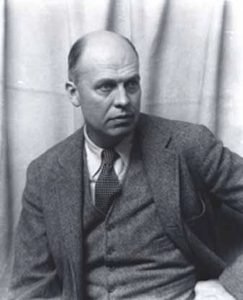
No other artist managed to capture the solitude within the modern city like Edward Hopper. The ‘artist of empty spaces’ offers a remindful look at life of Americans during Great Depression. His suggestive imagery shares the mood of individual’s isolation with books of Tennessee Williams, Theodore Dreiser, Robert Frost, Jerome Salinger, as well as with canvasses of Giorgio De Chirico and Paul Delvaux. Hopper depicted the spirit of the time very subtly, showing it in the poses of characters, in the vast empty spaces around them, and also in his unique color palette.
Here are some of the most famous paintings by Edward Hopper:
Automat, 1927
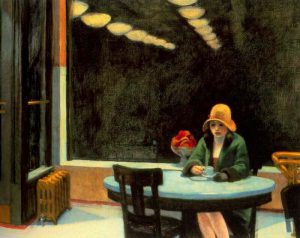
Automat was first displayed on Valentine’s Day 1927 at the opening of Hopper’s second solo show, at the Rehn Galleries in New York. By April it had been sold for $1,200. The painting is today owned by the Des Moines Art Center in Iowa.
The painting portrays a lone woman staring into a cup of coffee in an Automat at night. The reflection of identical rows of light fixtures stretches out through the night-blackened window.
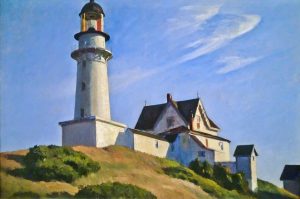
The Lighthouse at Two Lights, 1929
Edward Hopper’s early training from 1900 to 1906 at the New York School of Art with Robert Henri, leader of The Eight, and his work as an illustrator between 1899 and 1924, led him to paint realistic scenes of urban and rural America. In 1924 a successful gallery exhibition in New York enabled him to give up commercial work altogether and concentrate full time on painting. Hopper depicted his favored subjects: cityscapes, landscapes, and room interior’s solemnly, in carefully composed compositions that seem timeless and frozen but are animated by the effects of natural and man-made light. As fellow painter Charles Burchfield wrote for the catalogue of the Museum of Modern Art’s 1933 Hopper retrospective: “Hopper’s viewpoint is essentially classic; he presents his subjects without sentiment, propaganda, or theatrics. He is the pure painter, interested in his material for its own sake, and in the exploitation of his idea of form, color, and space division.”
In The Lighthouse at Two Lights Hopper isolated the dramatic silhouette of the 120-foot-high lighthouse tower and adjoining Coast Guard station against the open expanse of blue sky. Set on a rocky promontory in Cape Elizabeth, Maine – though no water is visible in the painting, the architecture is bathed in bright sunlight offset by dark shadows. Since 1914 Hopper had regularly summered in Maine, and this picture is one of three oils and several watercolors that he did of this site during summer 1929.
To Hopper, the Lighthouse at Two Lights symbolized the solitary individual stoically facing the onslaught of change in an industrial society. The integrity and clarity of his work made Hopper a quiet force in American art for forty years and one of America’s most popular artists.
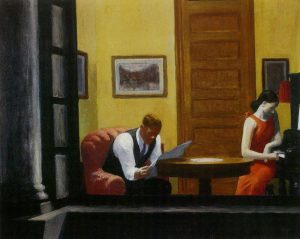
Room in New York, 1932
Throughout his life Hopper stated that his art was not an exact transcription of nature; it was a condensation of many scenes and impressions. “I’m always at a loss when asked for facts about any of my pictures or to describe how any one of them came to be made,” he told Lloyd Goodrich. “It is so often a very complicated mental process that would not interest people.” Hopper’s art depended on memory as well as inspiration. He searched for a typical scene, not a unique one, and found he frequently had to cull from a number of experiences and reduce them to a common denominator to make his art. The real world was often too unique, and a specific locale frequently did not render the commonality of the true “American scene,” a term he later learned to hate because it became associated in many people’s minds with a nostalgic and Romantic view of the world.
His description to Lloyd Goodrich of the origins of Room in New York (1932) underscores his method of creation. “The idea for Room in New York had been in my mind a long time before I painted it. It was suggested by glimpses of lighted interiors seen as I walked along the city streets at night, probably near the district where I live (Washington Square), although it’s no particular street or house, but it is rather a synthesis of many impressions.“
The viewer implied in this painting is a city dweller who, like a voyeur, knows intimate aspects of strangers’ lives. Hopper has chosen to blur the facial features of couple here and shows them as types, thus indicating that our view of their world does not allow us to understand them as individuals.
Cape Cod Evening, 1939
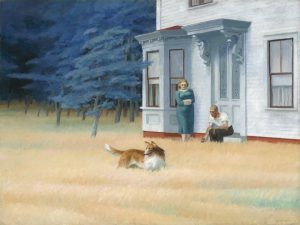
Cape Cod Evening is concerned with the loss of a viable rural America: it focuses on those people and places that have been left in the wake of progress. Today it is rarely remembered how enormous were the differences between the rural and urban population the late 1930s. At that time three out of every four farms were lit by kerosene lamps.
Cape Cod Evening was created the same year as the New York World’s Fair, which was entitled The World of Tomorrow. The fair featured a robot called Elektro, which could talk and smoke, and an exhibit organized by GM entitled Futurama. Designed by Norman Bel Geddes, the GM exhibition drew twenty-eight thousand paying customers a day who sat on a conveyor belt armchair for fifteen minutes and listened to a recorded voice explaining what the American landscape would be like in 1960. To a generation that had been burdened by the Depression, Bel Geddes’s predictions were less important for their accurate forecasting than for the fact that he was offering people an opportunity to begin thinking optimistically about the future.
New York Movie, 1939
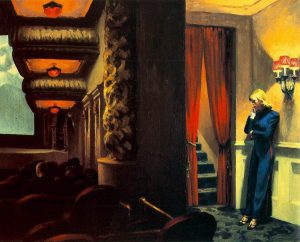
A movie theater in New York, one of those elaborate mock palaces where Hollywood spirits us for a few hours into another world – in this case apparently the high mountains. Spirits us as audience, that is, but not the usher, who has probably seen the movie a thousand times and waits for the curtain, mulling over her own thoughts. Her stationary figure counterpoints the screen with its incessantly flickering illusions of places not here and not now.
Like most of the female figures in Hopper’s paintings, this one was based on his wife, Jo, who posed standing under a lamp in the hall of their apartment. As the many preliminary studies for the picture show, Hopper not only drew his wife in various different poses for New York Movie, but precisely designed the auditorium decor, down to the pattern of the carpet. Again and again he sketched the foyers, stairways, and auditoriums of his favorite movie houses, the Palace, Globe, Republic, and Strand.
The entire painting is concerned with leavetaking, with seeming to be sated with a wealth of illusions that includes the film and the building, and with allowing this artificial world to lull one into thinking that life is not alienating and that the modern world is wonderful because it provides larger-than-life experiences in the theater. The usherette who is caught up in her own daydreams and the isolated spectators, however, point up the hollowness of this sumptuous and action-filled world. The usherette is a twentieth-century counterpart to the bored waitress in A Bar at the Folies-Bergeres of Edouard Manet. Similar to Manet, Hopper has a genius for making the illusory world of the theater so enticing, so glamorous, and so completely empty. He tantalizes his assumed viewer with an almost mystical apricot light that illuminates the steps that lead out of this unreal world where the usherette stands guard.
Ground Swell, 1939
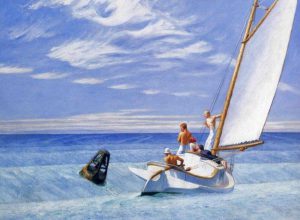
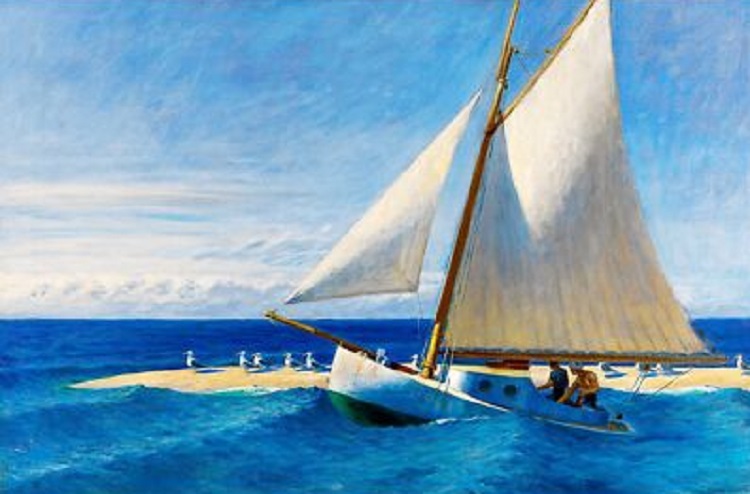
Edward Hopper’s lifelong enthusiasm for the sea developed when he was a boy in Nyack, New York, then a prosperous Hudson River port with an active shipyard. Years later, in 1934, he and his wife built a house and studio in South Truro, Massachusetts, where he produced a number of oil paintings and watercolors manifesting his avid interest in nautical subjects. In this quiet and voyeuristic view, the several figures aboard the boat are disengaged from each other. Their gazes seem fixed on the bell buoy, and their resulting trancelike state is reinforced by the rolling waves beneath them.
A ground swell is often caused by a far-off storm felt even under clear skies – causing a buoy to ring even when there’s no danger. The idea of threat in an idyllic setting has crucial precedents. Look longer, viewers will notice standard Hopper themes – mystery, loneliness, alienation.
Nighthawks, 1942
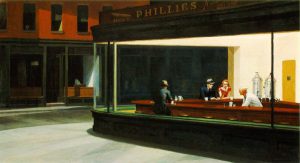
Nighthawks is a 1942 painting by Edward Hopper that portrays people sitting in a downtown diner late at night. It is Hopper’s most famous work and is one of the most recognizable paintings in American art. Within months of its completion, it was sold to the Art Institute of Chicago for $3,000, and has remained there ever since.
The four anonymous and uncommunicative night owls seem as separate and remote from the viewer as they are from one another. (The red-haired woman was actually modeled by the artist’s wife, Jo.) Hopper denied that he purposefully infused this or any other of his paintings with symbols of human isolation and urban emptiness, but he acknowledged that in Nighthawks “unconsciously, probably, I was painting the loneliness of a large city.”
Nighthawks was probably Hopper’s most ambitious essay in capturing the night-time effects of manmade light. For one thing, the diner’s plate-glass windows cause far more light to spill out onto the sidewalk and the brownstones on the far side of the street than is true in any of his other paintings. As well, this interior light comes from more than a single lightbulb, with the result that multiple shadows are cast, and some spots are brighter than others as a consequence of being lit from more than one angle. Across the street, the line of shadow caused by the upper edge of the diner window is clearly visible towards the top of the painting. These windows, and the ones below them as well, are partly lit by an unseen streetlight, which projects its own mix of light and shadow. As a final note, the bright interior light causes some of the surfaces within the diner to be reflective. This is clearest in the case of the right-hand edge of the rear window, which reflects a vertical yellow band of interior wall, but fainter reflections can also be made out, in the counter-top, of three of the diner’s occupants. None of these reflections would be visible in daylight.
Hopper’s biographer, Gail Levin, speculates that Hopper may have been inspired by Café Terrace at Night by Vincent van Gogh, which was showing at a gallery in New York in January 1942. The similarity in lighting and themes makes this possible; it is certainly very unlikely that Hopper would have failed to see the exhibition, and as Levin notes, the painting had twice been exhibited in the company of Hopper’s own works. Beyond this, there is no evidence that Café Terrace at Night exercised an influence on Nighthawks. Although there is no evidence at all (other than the fact that Hopper admired the story), Levin also suggests that he may have been inspired by Ernest Hemingway’s 1927 short story, The Killers.
Cape Cod Morning, 1950
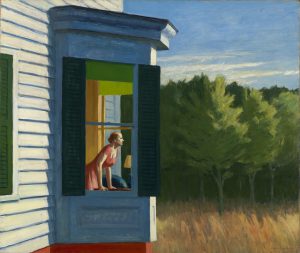
When Hopper paints a house, a balcony, or an interior, he leaves no doubt as to the time of day. We see morning sunlight slanting through a curtain, or the noontime glare, late afternoon shadows, approaching dusk, or night, a tiny corner of a night in the big city, illuminated by electric lamps, spotlights, neon signs. In every picture we know precisely what time of day or night it is, and at the same time we sense that time is standing still, and that nothing will change. We know that for the person standing at that window or seated at that table, this is the one, inescapable reality, at once representing the universe and a tiny slice of it.
Hopper gives us clues as to the nature of this existence, a thousand details presented with the utmost clarity. And yet we sense that, ultimately, we can know absolutely nothing about it. The only thing we can be certain of is our own ignorance.
In Cape Cod Morning, a woman looks out, tempted to the window by the morning sun, narrowing her eyes against the bright light. It is a moment of boundless expectation. But it has been depicted by a man who knew what afternoon and evening would bring, who knew that these great expectations were bound to be disappointed. With the emptiness and loneliness of the evening picture, which he painted first, Hopper anticipated the ultimate meaning of materialistic human existence.
By Alex Arlander | ENC News