Is the Christmas solar parade of planets in January 2026 a sign of great changes towards the light awaiting humanity and Earth?
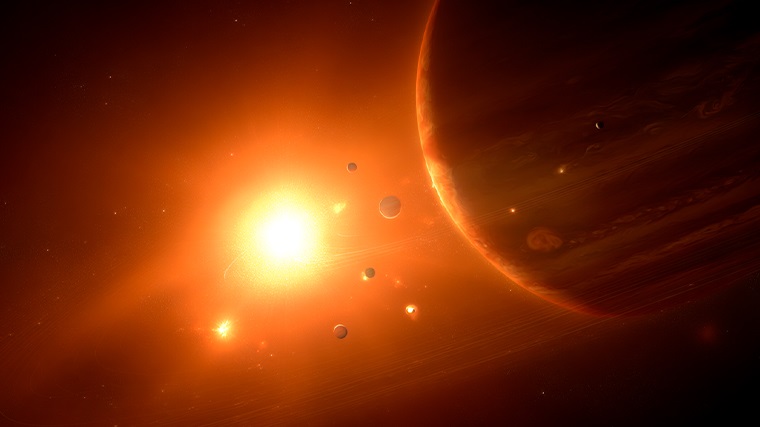
On January 7, 2026, humanity witnessed a rare astronomical phenomenon, the solar parade of planets, which coincided with the feast of the Nativity of Christ, celebrated by many Eastern Christians on that date.
On that day, the Sun, Venus and Mars lined up almost in one line, creating the effect of a bright point of light resembling the Star of Bethlehem.
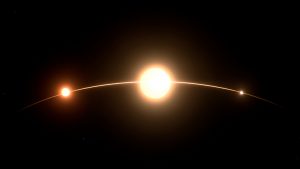
According to scientists, the convergence of the Sun, Mars and Venus is an extremely rare event, it occurs no more than once every few centuries. The next one will happen only in June 2267. Earlier it happened in July 1669, April 1682 and June 1968.
Interestingly, such rarest astronomical phenomenon, as the solar parade of planets on January 7-8, took place 20,000 years ago (!).
What is a parade of planets?
A parade of planets is an optical effect associated with the movement of planets around the Sun. When several planets are approximately in line from the point of view of an observer on Earth, it seems as if they are “aligned in a row” in the firmament.
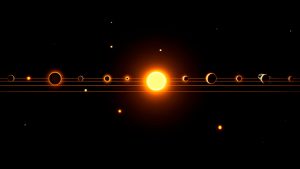
“The parade of planets is an optical illusion. It seems that the planets are side by side, but in reality they are separated by distances of hundreds of millions of kilometers. This is because their orbital motion temporarily aligns them on the same line relative to us.” said Honorary Doctor of Sciences Sergey Chumakov.
The scientist explained that a “solar” parade is one in which the planets line up on both sides or on one side of the Sun.
The solar parade of planets in January 2026
Elena Orlova, President of the “Science. Art. Technologies” Foundation, space design researcher said that especially impressive will be the final phase, the culmination of this solar parade of planets.
“On January 22, Mars, Venus and Mercury will be almost at the same point next to the Sun. This is a rare configuration, because the orbits of all three planets are tilted at different angles. In order for the angular distance to be reduced to one degree, a special geometry of the movement of bodies is required, which is formed only once every few centuries,” the expert said.
Despite the spectacular nature of the phenomenon, it is impossible to see it with the naked eye. According to Sergey Chumakov, the solar parade of planets takes place very close to the Sun, this means it is in the daytime sky. “The light of the Sun completely covers the radiance of the planets. Using a telescope, you can damage your eyesight if a sunbeam hits the optics. Such phenomena are recorded exclusively with the help of scientific equipment — coronographs and satellite instruments,” the expert explained.
Elena Orlova also said that for a wide range of observers, the event remains theoretical. “Unfortunately, we are not able to see this parade of planets: the light of the Sun “overpowers” the light of the planets. Even with binoculars or a telescope, it is unsafe to observe the phenomenon: accidental sunlight entering the optics can damage vision. Therefore, this parade of planets remains an event that can be traced only by astronomers’ calculations, and not in the night sky,” the researcher said.
What is unique about the Christmas parade of planets in 2026
According to calculations by the Laboratory of Solar Astronomy at the Institute of Space Research and the Institute of Solar-Terrestrial Physics of the Russian Academy of Sciences (IKI and ISSF RAS), the conjunction of Mars and Venus with the Sun will occur only four times in the current millennium: in January 2026, in June 2267, in December 2324 and in December 2623.
Scientists especially emphasize not only the rarity of the configuration itself, but also the coincidence of the astronomic event with the Nativity of Christ, celebrated by many Eastern Christians on January 7. According to astronomers’ estimates, the probability that such a close connection of the planets with the Sun will occur on a specific calendar day is about once every 20 millennia.
On the night of January 6-7, Mars and Venus approached the Sun and were located at a distance of about 1 – 1,2 degrees — Mars on the left, Venus on the right. That was the maximum visual convergence corresponding to the Christmas period.
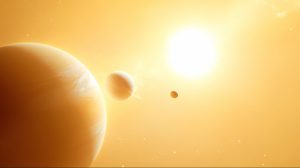
The four-rayed Star of Bethlehem
An additional uniqueness of the configuration will arise on January 22, 2026 when Mercury will join the “parade” of Venus and Mars. On this day, all three planets will be at the minimum average angular distance from the Sun. Venus, Mercury and Mars together with the Sun will form an almost even diamond-shaped configuration visually resembling the four-rayed Star of Bethlehem.
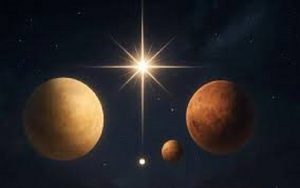
Astronomers will have to wait until June 2235 to see the next such phenomenon.
The convergence of all three planets near the Sun (within 10 degrees) is expected only in September 2038.
By Alex Arlander | ENC News