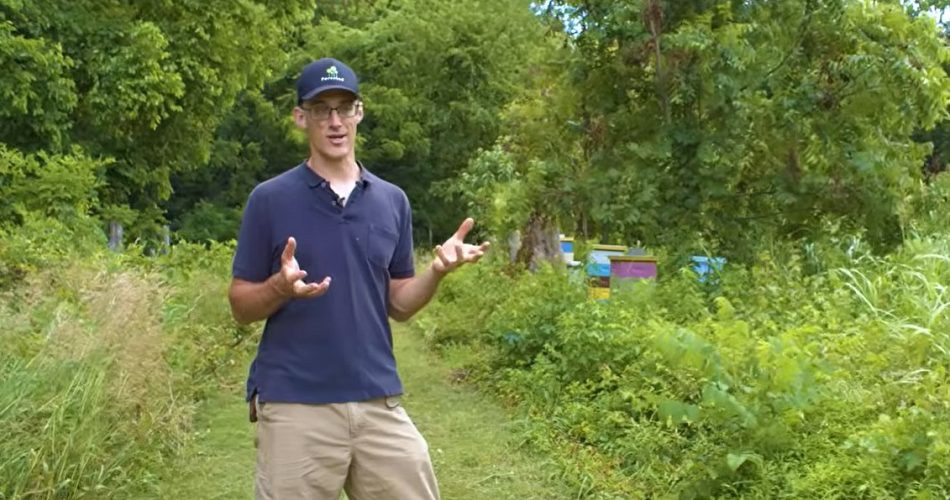
Lincoln Smith, founder of Forested, an amazing forest garden in Maryland, and a researcher at heart says: “I grow food and heal the Earth”
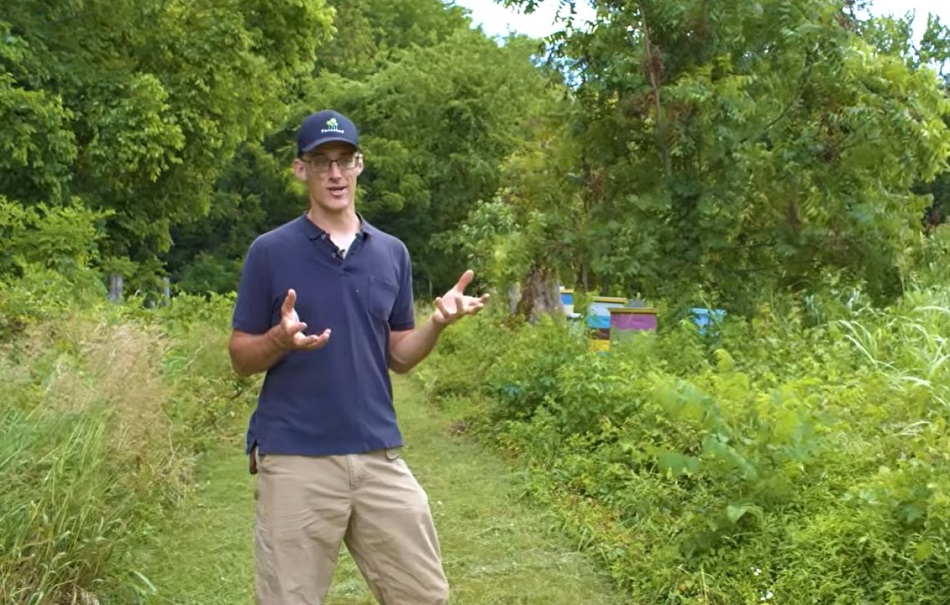
The term “agriculture” tends to elicit images of expansive open spaces with perfectly aligned rows of crops. Lincoln Smith, founder of Forested, has an entirely different vision. Forest farms — or forest gardens, the term preferred by Smith — tend to look more like a forest than a farm.
With a background in landscape architecture, Smith has always been interested in the way people relate to the land. He quit his high-end landscape architecture firm to experiment and advance forest agriculture.
He started his “forest garden” in 2012 on 10 acres of former cornfield that he leases from the church he’s attended since childhood, located in Bowie, Maryland. He started Forested to research forest gardening methods, market forest foods, train people in forest gardening, design forest gardens, and raise awareness about the practice through tours and classes.
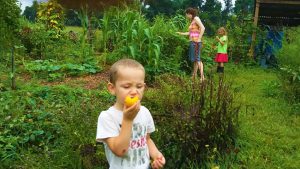
Smith says, “As the forest grows, people come just to walk around, pick its fruits and attend workshops and other events like the twice-yearly Forest Feast, a multicourse, forest-to-table chef meal.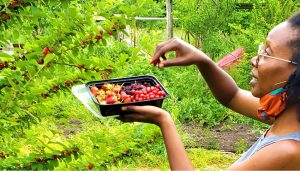 ”
”
Is it permaculture? How about agroecology?
Smith speaks about the importance of agroecosystems, why National Parks alone won’t solve our environmental challenges, and what non-farmers should know about growing food.
“Permaculture” and “Agroecology” mean pretty similar things. I personally prefer “agroecology,” says Lincoln Smith. “Forest garden” = “Edible Forest Garden” = “Food Forest”
“Forest gardening is a form of agroecology suitable for the forest biome. For the grassland biome, forest gardens are not appropriate – agroecology systems based on the grassland are called for. But in the eastern U.S., this is a forest, so we need forest gardens to restore ecosystem health while feeding people.”
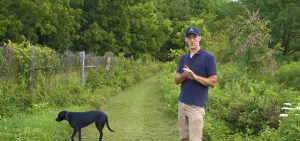
So there Lincoln and his team are experimenting with what grows best – on this very land – with the least amount of inputs, including labor. So they measure their yields – it’s citizen science. They’re producing food and restoring the ecosystem at the same time. Lincoln has heard the doubters and skeptics and seems to answer them at the end of his excellent “Forest’s 10-year anniversary” video.
Small forest garden projects like his are not going to individually change the world but every project does have a role to play in increasing our knowledge and increasing the conversation about how we can better work with and benefit from the ecosystems where we live.
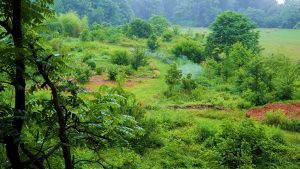
It’s a lifetime of discovery and excitement to figure out the plants and the culture around those plants that can take us to a future where hopefully our ecosystems are restored at the regional scale, wildlife habitat is improved, water quality is improved, and people are eating better so that they are healthier and more integrated with their local ecosystem: the amazing forests of the eastern United States or any other you live in.
Lincoln Smith says that his first task was to heal the soil, made low in organic matter by years of corn production. “Over time…the forest’s productivity could begin to rival that of conventional farms.” He calculates that mature red oak trees can churn out as many calories per acre in the form of acorns as can wheat. For those willing to wait, “the forest works…This ecosystem is incredibly productive … and there is a tremendous amount of yield potential there that we can tap into,” he says. “Studies have even found higher insect diversity in forest gardens than in native forests allowed to grow ‘on their own.’”
The plants – what’s worked so far, and what hasn’t.
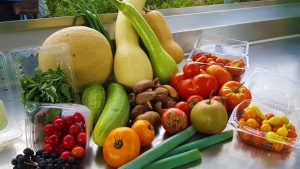
Now, Smith and crew harvest many native and nonnative fruits and berries from the bushes, gardens and trees that cover the landscape.
“We have over 100 species that we’ve planted, as well as many species that we didn’t plant, that are wild and that we’ve allowed to come in and grow here,” Smith says. “We grow in layers,” he says. “We have big trees together with understory-size trees and shrubs and vines and patches of vegetables, and native flowers to support beneficial insects and habitat for the birds that eat those insects.”
Mulberry trees can keep birds from eating blueberries. They’ve found that the Illinois everbearing mulberry is the best. It’s super-easy and very productive.
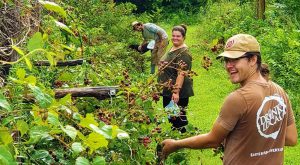
The native oaks grown there are the ones with the largest acorns. Harvesting and processing them is very labor-intensive. Black locusts are very useful. They improve soil and make great fencing, too.
Onto the wild American persimmon trees Lincoln has graft improved American persimmons and improved Asian persimmons. These grafted trees produce fruit that’s superior to the wild trees’ fruit. Lincoln says, “Americans are not reaching for persimmons because they don’t like the astringent under-ripe ones, which also have no shelf life. They do make for great dried fruit, though.”
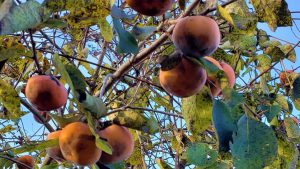
Aronia is a very productive native plant. They also grow the easy wild gooseberries, which are smaller than the cultivated type.
Lincoln calls highbush cranberry “pretty nasty” and black chokeberry “bitter,” and he hasn’t found any native cherries that he likes.
Yaupon hollies are great. The contraption that dehydrates the leaves before roasting, results in a “great tea.” It’s the only native plant with caffeine; the tea can be ordered online. Yaupons are probably Asian, because of the name. But one should note that the berries are toxic to humans; it’s the leaves that are edible.
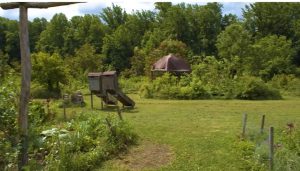
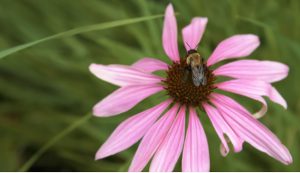
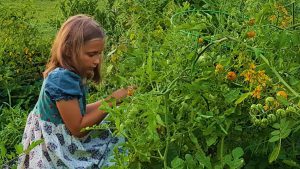
For vegetables, they choose the ones requiring the lowest possible maintenance. Sunchoke is a terrific root crop that’s low-care, as is squash. They’ve tried potatoes but have had more success with sweet potatoes. It’s all about minimizing labor. Ostrich fern is Lincoln’s favorite shade vegetable. Lamb’s quarters are great to eat, similar to spinach. Cut-leaf coneflower (a/k/a Sochan) is a wonderful native leafy green vegetable, harvestable from April into October. Baptisia is grown there because it’s so good at fixing nitrogen. Edible Black-eyed Susans also grow at Forested. Mimosa, an invasive plant that was on the property already, is left in place and treated with a Permaculture technique called chop and drop. Comfrey is treated the same way.
They have their own small apiary where they extract fragrant forest honey.
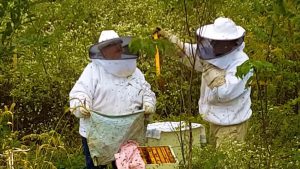
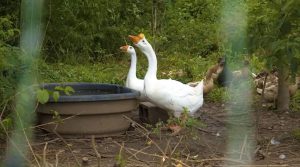
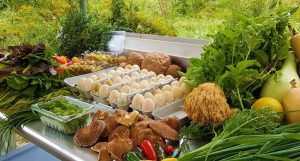
They raise ducks at Forested and get excellent eggs.
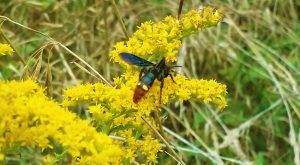
When the garden started, Japanese beetles were a huge problem. But right out of an organic gardening textbook, the problem was brought under control by planting goldenrods, which attract the Blue Wing Wasps, which eat the beetles. Amazing how that works!
Design/Techniques
Lincoln says he doesn’t like “inaccessible forest gardens,” so it’s important to mow the paths. With no plant encroachments over the paths, visitors feel safe, not claustrophobic. “It’s a people habitat.”
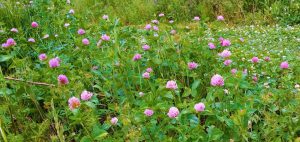
He’s found that white clover is perfect for paths because it can take mowing – while at the same time fixing lots of nitrogen. The taller red clover is also great at improving soil and is grown in unmown parts of the garden.
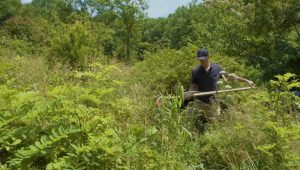
Smith uses a traditional sythe to hack the undergrowth back as needed.
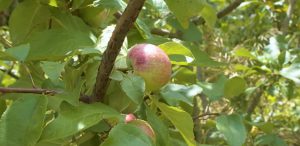
For peaches and apples, he uses the clay-based Surround, which unfortunately deters all insects.
Lincoln is cautiously open to the use of GMO technology in the effort to produce blight-resistant American chestnuts.
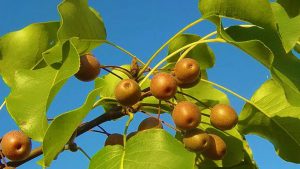
The wildly invasive tree Bradford pear was already on the property, but it makes an excellent root stock for Asian and European pears! The graft results in easy, trouble-free pear trees, fruiting the very next year.
So it is a nice surprise that Lincoln’s exploration of what works on this specific plot of land won many skeptics over, big-time! Even purists are so impressed with the scope of what he’s discovering and its potential to be useful in known and unknown ways, they give him a pass on using invasive Bradford pears and being open to plants from anywhere, and technology, too.
About using the hated Bradfords that predate him on the land, Lincoln says it’s like “Like catfish in the bay.”
Many visitors love what’s happening at Forested because they’re advancing forest agriculture in the only way it really can be advanced – by observing the land, not by following any rigid ideology, and notably not by blaming humans as innately harmful beings whose needs should have no place in the world. Lincoln’s attitude – “It’s a people’s habitat” – sets him apart. Instead of trying to banish humans from nature, his forest garden welcomes us into a healthy, mutually beneficial partnership with it.
If you’re wondering how Lincoln is making this work financially, he says “The majority of my not-very-good-but-improving income is from designing, installing and maintaining public and private edible forest gardens for clients. The garden in Bowie is our test best; most of our clients visit it before they hire us.”
Agroecology in the garden?
As impressive as Lincoln’s innovative research is, you may also be wondering: how applicable is it to gardeners? Well, of course, some of you would like to grow edibles but can’t commit to tending the typical high-maintenance veg garden, for a variety of good reasons. With knowledge of super-easy edibles like gooseberries and cut-leaf coneflowers, more of us might do it. That goes for people who want to dine on the harvest as well as people who’d happily leave the fruits and berries for wildlife to consume.
And how to incorporate “forest garden” plants and techniques into residential or even a public garden, where aesthetics are important to some degree? Lincoln invites those who are interested to see the examples to visit both residential and public spaces nearby – and to share their opinions about what they saw there.
By Gilbert Castro |ENC News